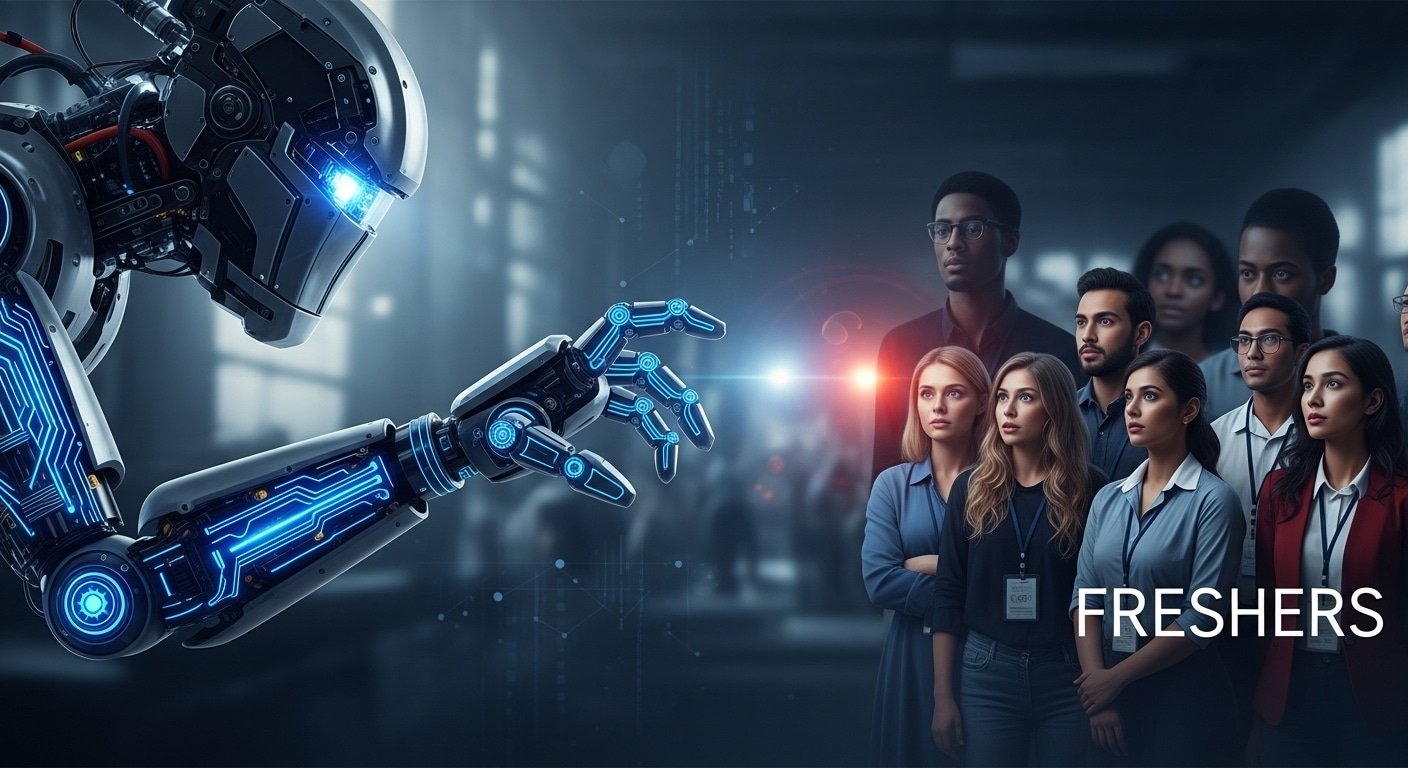
Jobs at risk from AI 2026: Artificial intelligence is no longer a future concept. It is already being used across industries, from software development to customer support. But one question continues to worry freshers and job seekers: Will AI take away jobs?
Recent research suggests that while AI is not replacing jobs immediately, it is slowly reshaping how work is done. Some roles are already seeing changes, and others may follow in the coming years.
For freshers entering the job market in 2026, understanding this shift is becoming essential.
Get Direct HR Email IDs for Faster Job Apply (Updated Daily)
These Jobs Are Most at Risk From AI
Not all jobs are equally affected. Roles that involve repetitive tasks, structured data, and predictable workflows are the most exposed.
Jobs most likely to be affected include:
- Computer programmers
- Data entry operators
- Customer service representatives
- Software testing and QA roles
- Market research analysts
- Financial analysts
- IT support roles
- Sales support functions
- Medical record management
These roles often involve tasks that can be automated using AI tools, especially those powered by large language models.
Why These Jobs Are More Vulnerable
AI systems perform best when tasks are:
- Repetitive
- Rule-based
- Data-driven
- Structured
For example, a data entry job involves entering and processing information based on fixed rules. Similarly, customer support often follows predefined scripts.
AI tools can now handle such tasks faster and at scale.
As one insight from recent research suggests:
“Tasks that are predictable and structured are the easiest to automate with AI systems.”
Example: The Changing Role of Software Developers
One of the biggest surprises is the inclusion of programming jobs in the risk category.
With AI coding tools becoming more advanced, developers can now generate code, debug issues, and even design systems faster than before.
However, this does not mean developers will lose jobs completely. Instead, their roles are evolving.
Future developers will need to focus on:
- System architecture
- Complex problem-solving
- Reviewing and managing AI-generated code
In simple terms, coding is not disappearing — it is changing.
AI Is Still Not Fully Replacing Jobs
Despite the concerns, it is important to understand that AI is still in its early stages.
In many industries:
- AI is used as a support tool
- Humans still make final decisions
- Full automation is rare
Even in high-risk roles like finance and engineering, most tasks are not yet fully automated.
This means that while AI has the potential to replace certain tasks, complete job replacement is still limited.
Why Companies Are Not Fully Relying on AI Yet
There are practical reasons why AI adoption is still controlled:
- AI can make errors or produce incorrect outputs
- Complex decision-making still requires human judgment
- Systems may fail in real-world scenarios
- Trust in AI is still developing
Because of these challenges, companies are currently using AI to assist employees, not replace them entirely.
Freshers May Face More Competition
One important impact of AI is on entry-level hiring.
Companies are slowly reducing hiring for roles that can be partially automated. This means freshers may face:
- Fewer entry-level openings
- Higher skill expectations
- Increased competition
For example, tasks that were once assigned to junior developers or support staff may now be handled with the help of AI tools.
This does not eliminate opportunities, but it raises the bar.
Some Jobs Are Still Safe From AI
While many roles are evolving, some jobs are less likely to be affected.
These include:
- Skilled trades (electricians, mechanics)
- Jobs requiring physical work
- Roles involving human interaction and creativity
- Leadership and decision-making positions
These jobs rely on skills that AI currently cannot replicate effectively.
What Freshers Should Do Now
Instead of worrying about AI, freshers should focus on adapting.
1. Build Skills Beyond Basics
Basic coding or data handling is no longer enough. Focus on:
- Problem-solving
- Real-world applications
- System thinking
2. Learn How to Use AI Tools
AI should be seen as a tool, not a threat. Learn:
- AI-assisted coding
- Automation tools
- Data analysis platforms
3. Focus on Practical Experience
Projects, internships, and real-world exposure are becoming more important than theoretical knowledge.
4. Improve Communication Skills
As automation increases, roles that require human interaction will become more valuable.
The Bigger Shift: Jobs Are Changing, Not Disappearing
Every major technological change has raised similar concerns.
From machines in factories to computers in offices, each wave of innovation has transformed jobs rather than eliminating them entirely.
AI appears to be following the same path.
The key difference is speed. Changes are happening faster, and adaptation is becoming more important.
Final Thoughts
The idea that AI will replace jobs overnight is not accurate. However, the nature of jobs is clearly changing.
For freshers in 2026, the focus should be on staying relevant. Roles that rely only on repetitive tasks are at higher risk, while those that require creativity, problem-solving, and adaptability will continue to grow.
The job market is not shrinking — it is evolving.
Those who understand this early and prepare accordingly will have a clear advantage.
Read More- Oracle Layoffs 2026: One Engineer’s Quiet Comeback Shows a Different Side of Job Loss
Also Read & Apply
👉 Also Read:[Latest IT Jobs for Freshers in India — 2026 Top Openings]
👉 Also Apply: [Work From Home Jobs 2026 — Top Companies Hiring Now]
Disclaimer
This article is based on recent research and industry trends. It is intended for informational purposes only and should not be considered career advice. Individuals should make decisions based on their own skills and circumstances.